
Painting in the Anthropocene

On the Planetary Scale of Painting
An Introduction to the Open-Access Publication Painting in the Anthropocene
By Lu Xinghua
0.
From the canvas to the easel, from the studio to painting within the framework of 6,000 years of human painting history, and now to painting in the Anthropocene, amid global warming, within the biosphere and across planetary space—we have ultimately arrived at planetarism in painting.
Needless to say, painting today takes place within deep history.
The inability—or stubborn refusal—to acknowledge this bottomless depth and planetary scale of painting, the attempt to deceive ourselves while inadvertently revealing precisely what we wish to conceal, and the repeated failure to understand what is happening even after running headlong into one wall after another: these are the unmistakable symptoms of the contemporary painting world's decline.
Behind these symptoms, however, one thing becomes increasingly clear: the planetary scale has become the single indispensable supporting structure that sustains the very spirit and vitality of painting today.
Painting requires a planetary scale, yet painting is also a means through which we search for that scale. The two are interlocked.
Should we remain behind closed studio doors, creating and cataloguing our works? Or should we decisively open our already flooded studios to the biosphere, working through attunement and entanglement, drawing strength from distances beyond the distant, so that we may continue painting in the Anthropocene—and, in the process, perhaps save painting itself?
The planetary scale is the scale of survival embodied by the mushrooms growing in an Oregon forest devastated by wildfire, as described in Anna Lowenhaupt Tsing's The Mushroom at the End of the World. It is a new scale discovered by survivors as they look around and find their bearings within the biosphere.
The planetary scale of painting, or planetarism in painting, refers to a contemporary aesthetic, ethical, and political scale that no longer takes the 6,000-year history of human painting as its ultimate point of reference.
It is a new scale of symbiotic existence within the biosphere, learned from the mushrooms emerging from ruins—a scale that offers a way out of the dead end of global warming.
Painting must recalibrate this new planetary scale for us every day.
1.
Francis Bacon's paintings pay homage to 6,000 years of human painting history, from the pyramids to Cézanne, with Raphael and Michelangelo serving as intermediary figures and Rembrandt marking the beginning of the modern era.
This is the human scale of painting.
The planetary scale of painting reverses this perspective.
It means recognizing, amid global warming, when everything is being flooded and even our studios are taking on water, that we have no choice but to paint within deep history.
We must use painting to search for a scale of human symbiosis.
At the same time, we must actively become versatile practitioners capable of drawing upon the entire history of global painting as our own repertoire, treating even its most demanding technical achievements as备用 tools kept in our pencil cases.
We must paint according to a planetary scale that is constantly being recalibrated.
This means painting from a position of greater withdrawal, acting from a greater distance and through a more radically recursive movement in the opposite direction.
It means understanding painting as a practice of attunement and entanglement on a planetary scale.
This is what it means to paint in the Anthropocene.
2.
Painting in the Anthropocene: On Wang Jianwei's Planetarism in Painting took four years to write, during which it underwent a complex process of learning and experimentation.
Even after the manuscript was completed, another development occurred: Wang Jianwei used photography as a quantum apparatus to document his studio environment and the collapse of his classical painting habits.
The material reality of the carbon traces left by the photographic shutter pushed painting and writing to the margins.
In terms of the book's content, photography possesses a greater degree of reality, while painting and writing function as its experimental propositions and records.
From a distance, the author and Wang Jianwei witnessed together the collapse of Wang's studio and his classical painting process.
After retrieving painting from this collapse and relocating it onto a planetary scale, they came to a shared realization:
To paint today is simply to paint global warming from within global warming—as Timothy Morton demands.
It is to enact the biosphere from within the biosphere—as Graham Harman proposes.
It is for the artist to emerge through a composting relationship with their own work—as Bruno Latour acknowledges.
According to Harman, painting should generate an object greater than the painter and the painting combined.
It should produce a third object: a new object, a new work, larger than the painting on the easel.
Through painting, the painter moves toward a larger painting.
This is what painting in the Anthropocene means: painting global warming while immersed in global warming, and painting the biosphere from within the biosphere itself.
The painter continually withdraws farther from the easel until reaching a position from which painting takes place within the Anthropocene.
Every painter today must reckon with this planetary scale.
This is the most important insight that Graham Harman's object-oriented ontology offers Wang Jianwei's painting practice.
Painting in the Anthropocene is therefore both a study of Wang Jianwei's planetarism in painting and an investigation into the aesthetics of Harman's object-oriented ontology and speculative realism.
3.
The world we create and inhabit is entangled with many other worlds.
We exist among the multiple dimensions and multiplicities of this planet.
According to Dipesh Chakrabarty's One Planet, Many Worlds, a planetary scale must account for the entanglements among different forms of life.
The contributions of bacteria and ephemeral organisms to the production of oxygen, for example, belong to the planetary scale that human observers must take into consideration.
Donna Haraway, Anna Tsing, and Bruno Latour have provided us with the imagination and insights necessary to understand this scale and these entanglements.
There is one planet, but humanity is multiple—divided in many different ways, yet interconnected.
The planet guides us toward relationships across differences and toward forms of kinship among distinct human communities.
Yuk Hui approaches the importance of the planetary for artistic practice from another perspective.
In Art and Cosmotechnics, he argues that if we are not to return to a European conception of Dasein, we must seek another beginning.
This other beginning must be grounded in a planetary scale, rather than in the scale of China, New Confucianism, or the notion of a community with a shared future for humanity.
He asks:
Can art reveal the truth concealed within the calculative, planetary mode of modern technology?
Can we search for another beginning within art?
Within art itself, rather than merely through art?
(p. 74)
Hui is suggesting that we use art to apprehend the planetary scale.
To paint in the Anthropocene, to paint global warming from within global warming, is to grasp a planetary scale that must be constantly challenged and reassessed—a scale capable of guiding humanity's practices of symbiotic coexistence.
In Machine and Sovereignty, Yuk Hui further argues that thinking the planetary requires thinking beyond the nation-state.
It requires us to think collectively about humanity's becoming and about the freedom that defines every political struggle.
Yet this planetary freedom still awaits identification and articulation, because we do not yet know how to conceive planetary rights, or how to enable both human and nonhuman beings to exercise such rights (p. 86).
Should we move toward a planetary organicism under this new scale?
If this remains politically unattainable, should we allow art—or painting—to take the lead?
New Open-Access Book
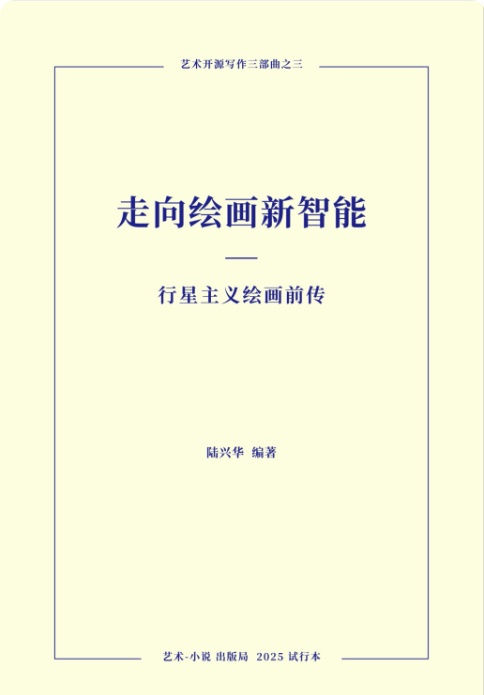
Painting in the Anthropocene: On Wang Jianwei's Planetarism in Painting
Access the book through the following link:
Translation Note: This article was originally written in Chinese by Lu Xinghua and published on the WeChat Official Account Art–Novel (艺术—小说). The English translation was prepared by ChatGPT (OpenAI) at the request of Contemporary Front.
Lu Xinghua (b. 1964, Shaoxing) is a Professor at the School of Humanities at Tongji University. His research primarily focuses on French philosophy, with particular attention to political philosophy, aesthetics, and art theory. His recent studies have focused on Derrida, Baudrillard, Luhmann, Agamben, Badiou, and Zizek. His translations and publications include Representation: Cultural Repressentations and Signifying Practices, Exigence Partagees, The Anthropocene and Platform Cities: Urban Philosophy 1, Introduction to Art Exhibitions, The Future of Art and Politics: A Study of Jacques Rancière’s Aesthetic Thought, and Art in the Anthropocene – Stiegler’s Lectures at the China Academy of Art.
论绘画的行星尺度
--《在人类世画画》开源介绍
陆兴华
——————————0——————————
从画布到架上,从工作室到6000年的人类绘画史框架内去画画,再到今天的在人类世、全球变暖中,到生物圈里,到全行星空间内去画画,我们最终是走向了绘画的行星主义。
不消说,今天的画画是在一种深度历史里进行的了。没意识到、死不承认画画的这一无底性或行星尺度,还掩耳盗铃,但又此地无银三百两,像没事儿那样地一次次撞墙回来后仍拎不清,是今天的绘画界的真实萎貌。不得不说,这些症状背后,我们越来越看出:那一行星尺度才是撑起今天的画画的精气神的唯一的那根不可或缺的伞骨或钢丝了。
画画需要行星尺度,而画画却也是我们寻找这一行星尺度的手段。互锁。是在工作室内闭门创造和编目,还是果断地使进水的工作室内向生物圈敞开,在调谐和纠缠中工作,从远方的远方之外借力,来继续在人类世画画,先顺便先救了绘画?
行星尺度是我们能从罗安清的《末日松茸》里观摩到的那一被山火夷平的俄勒冈森林里长出来的蘑菇所抱的生存尺度,是幸存者在生物圈顾左右而找到的新尺度。画画的行星尺度或绘画的行星主义,是指不以那一人类6000年的绘画历史为依归的绘画的当代美学、伦理和政治尺度,是从全球变暖这一死胡同退出,从那一从废墟中长出的蘑菇那儿取经到的在生物圈内共生的新尺度。
绘画必须天天替我们校正这一新行星尺度。
——————————1——————————
培根的画是对金字塔到塞尚的人类6000年绘画史的致敬,以拉斐尔、米凯朗其罗为中继,以伦勃朗为现代开端。这是绘画的人类尺度。
绘画的行星尺度是倒过来,是我们身处全球变暖,在一切都在进水、连工作室也进水的情况下,主动意识到自己不得不在深度历史中来画画了,不得不用画画来寻找人类的共生尺度,并主动去成为将全球绘画史当自己的保留项目的全能选手,把全球绘画史难度动作当成铅笔盒里的备用工具,以时时被调校的行星尺度来画画。
这是更后撤地来画画,更远距离、更反向递归地来出手,是把画画当成行星尺度下的调谐术、纠缠术了。
这就是在人类世画画。
——————————2——————————
这本《在人类世画画--论汪建伟的绘画行星主义》的写作历时四年,中间被注入了曲折的学习和实验过程。完成后又经历汪建伟用摄影这一量子装置来记录他的工作室现场和经典绘画习惯的坍缩,摄影快门留下的碳迹的实在性,把绘画和写作挤到了边上。在内容上说,其中的摄影是更实在的,绘画和写作是它的实验构思和记录。
作者与汪建伟一起在远处目堵了他的工作室和经典绘画过程的坍缩,然后把绘画打捞、剥离到了行星尺度上之后,共同认识到:今天的画画只是在全球变暖中画全球变暖(Timothy Morton的要求),是在生物圈来演出生物圈(Graham Harman的提议),是在与自己的作品的堆肥关系里去诞生出作者自己(Bruno Latour的坦白)。
根据哈曼,画画是要形成一个比画家和画加在一起还更大的对象,得到第三个对象,一个比架上的画更大的新对象、新作品;画画,然后画家就走向了一张更大的画。这就是在人类世画画:画画而在全球变暖中画了全球变暖,在生物圈中画了生物圈。
画家从架上不断进一步后撤,后撤到了在人类世画画的位置上。今天的每一个画家都不得不掂量这一行星尺度了。
这是哈曼的以对象为导向的本体论对汪建伟的绘画工作的最重要启发。《在人类世画画》既是对汪建伟的绘画行星主义的研究,也是对哈曼的以对象为导向的本体论和思辨实在论的美学的研究。
——————————3——————————
我们所制作和居住的这个世界,是与各种其它世界纠缠的。我们身处这个行星的多重体之间。根据恰克帕蒂的《一个行星,多个世界》,行星尺度必须考虑不同生命形式之间的纠缠,比如细菌和蜉蝣生物对氧气的贡献,那就是人类观察者必须要考虑的行星尺度。哈拉维、安娜清和拉图尔为我们理解这种尺度和纠缠提供了想象和洞见。行星是一个,人类是多,被多重地切割,但互相关联。行星指点引了我们在差异之上关联,在不同的人类群体之间互相结亲。
许煜从另一个角度来思考了全行星对我们的艺术工作的重要性。在《艺术与宇宙技术》中,他指出,不回到欧洲式此在,我们就得找另一个开端。这另一个开端就是行星尺度,而不是中国或新儒家或人类命运共同体这一尺度。他问我们:艺术能揭示隐藏在现代技术的计算性、全行星模式中的真理?在艺术之中寻找另一个开端?之中?而不是通过它?(第74页)他是在建议我们用艺术去把握那一行星尺度。在人类世画画,在全球变暖中画全球变暖,就是去把握住那一需要时时被挑战的、指导人类的共生实践的行星尺度。
在《机器与主权》中,许煜进一步指出,思考全行星,就是要思考到民族国家之外,是要集体地思考人类的成为和思考那一定义每一种政治斗争的自由。但这一全行星自由仍有待被指认,因为我们还不会思考全行星权利和如何让人类和非人类来使用这一全行星权利(第86页)。在新的尺度下走向全行星有机论?这在政治上还做不到,所以我们应该让艺术或画画先行?
新开源书
点击以下链接直接获取;

Comments