
Toward a New Intelligence of Painting
A Painter’s Declarations, Achievements, and Legacy Must Be Distinguished
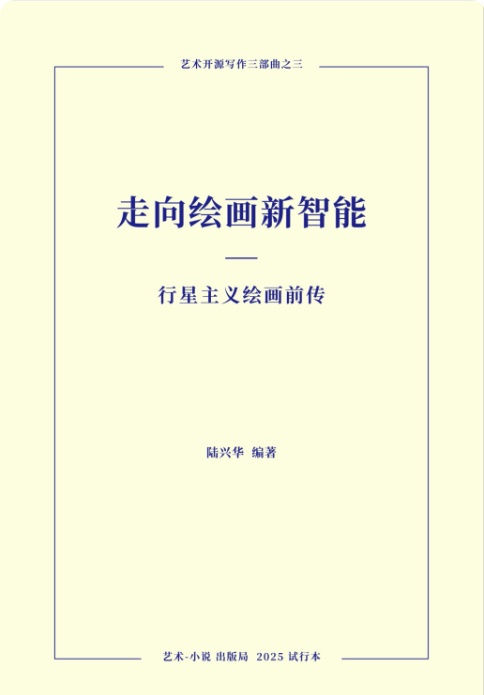
Introducing Toward a New Intelligence of Painting: A Prehistory of Planetarist Painting
By Lu Xinghua
0.
Declarations, achievements, and legacy form an impossible triangle that every celebrated painter holds in their hands.
1.
While examining the biographies, works, and critical reception of established painters, the author suddenly realized that, when discussing painting, we must distinguish three things:
The painter’s own personal declarations;
The prolonged, often questionable process through which peers and the art world identify and recognize her achievements;
The invariably somewhat suspect retrospective acknowledgment of her legacy by future generations.
In contemporary painting criticism, most writers entangle these three dimensions. As a result, the painter's fate becomes like a sticky rice dumpling rolling into a bowl of powdered sugar, emerging thoroughly coated and hopelessly muddled: what she declares about herself is taken as her achievement; what her peers regard as her achievement is treated as her legacy; and her legacy, reinforced by her continued fame, is retrospectively used to vindicate her original declarations.
Only by separating these three dimensions can we find the appropriate register in which to discuss painting. Only then can we disregard the painter's declarations, her peers' evaluations of her achievements, and the retrospective embellishments imposed by the market and its systems of commemoration, and undertake our own contemporary work as viewers: looking at paintings in order to paint.
We must emphasize that we look at paintings in order to bring painting into being. We look in order to paint, allowing images to become paintings in the present moment. Otherwise, the act of looking remains unfinished.
2.
A painter's declarations are successive personal manifestos issued in the course of her ongoing struggles with other painters, styles, and aesthetic preferences within the contemporary painting mine—or underworld.
Yet these declarations are themselves highly opportunistic. They reveal the solipsistic dimension of her personal methodology and remain profoundly ambiguous.
Her own artistic production and exhibitions continually subject these declarations to reassessment and elimination. She must keep subtracting.
She must become an abstractionist—and therefore, necessarily, a practitioner of subtraction.
What remains is simply her naked self, stripped of all those declarations that no longer belong to her.
Only toward the end of her career, perhaps after the age of sixty, might her personal declarations finally be taken seriously.
And it is precisely these declarations that lead her into danger throughout her career, especially once she herself begins to believe in them.
3.
Recognition by one's peers and the art world is the kind of recognition Hegel speaks of: the rather humiliating compulsion to prove something to that bewildering entity called the art world, and to the public.
In pursuit of this recognition, the painter struggles endlessly, suffers repeated wounds, endures hardship, and ultimately may find herself wandering far from home.
In the end, she may no longer value the assessments of achievement handed down by her jealousy-ridden peers. Even when recognition arrives, she may still feel wounded.
Under the weight of countless honors and titles, she risks becoming as ridiculous as some foolish professor who keeps collecting awards.
Perhaps genuine achievement should instead be measured by how many awards one has refused.
Yes, she has challenged the art world single-handedly, armed with all manner of declarations. Yet these declarations are often merely provisional, exploratory, or even strategic feints intended to distract from her real intentions.
Her achievements, then, are no more than a disorderly shower of rain falling upon her head. To take them too seriously would be absurd.
Recognition within the artistic field, institutional recognition, and market recognition—all these alluring but fleeting forms of acknowledgment—must eventually be converted into recognition through fame and monetary value.
Yet she will discover that this conversion begins to deteriorate almost immediately.
What, in the end, she will actually manage to obtain from it remains impossible to predict.
4.
The form of recognition most difficult to control concerns how a painter's legacy will be inherited by future generations.
This is the question that ultimately defeats the painter. She can never settle it before entering her coffin. She has no choice but to let go.
In The Human Condition, Hannah Arendt argues that every individual carries the legacy of previous generations while also wishing to leave something of their own natality—the irreducible uniqueness brought into the world through their birth—permanently within the public space of the community, as a monument to their existence.
Yet this public space has limited capacity. Everyone has an equal claim to it.
The painter, however, imagines that she alone is especially obsessed with this task. She even wishes to teach those around her to leave behind permanent marks of themselves.
One might recall the figures described by Michel Foucault in The Lives of Infamous Men: illiterate madmen, women accused of witchcraft, and murderers who, before their executions, left traces scratched with their fingernails and blood upon the white walls of their prison cells.
Such marks become a kind of legacy, left behind regardless of consequences.
Against all resistance, the painter desperately attempts to preserve something of herself, whether or not future generations are willing to make room for her.
But although the painter's desire to leave permanent traces of herself is genuine, whether future generations wish to inherit those traces is entirely their decision. There is no room for negotiation.
The painter can never know which of her personal traces will eventually count as her legacy—a predicament that filled Cy Twombly with anxiety during the final thirty years of his life.
Because painters cannot determine in advance what their legacies will be, the more celebrated they become, the greater their anxiety.
To insist on securing a legacy through the prices of paintings, the quantity of works produced, or institutional endorsement is to attempt, from beyond one's own reach, to dictate how future generations should remember, mourn, and commemorate the artist.
Such an attempt is excessively coercive and ultimately undignified.
In the world of painting after modernism, various forms of mourning for painting itself have proliferated.
As Thierry de Duve suggests, abstractionism, in its opposition to the classical tradition and its pursuit of formal completion, also turns against modernism's emphasis on touch and gesture, thereby driving itself toward large-scale reproduction.
Every painter who hopes to leave a legacy will likewise encounter future generations of abstractionist demolition crews, who may dismantle that legacy even more ruthlessly.
Robert Ryman, for example, sought to paint as though practicing a form of handmade photography, only to administer yet another final farewell to painting.
Even when one's ashes are left in the hands of posterity, they remain a source of trouble!
For a painter to seek a legacy is thus to rush willingly, almost eagerly, into this meat grinder.
Through their artistic production and exhibitions, painters openly attempt to prescribe how future generations should grieve, commemorate, and mourn them—regardless of whether such efforts will ultimately succeed.
5.
Before death, the painter desperately clutches three reins governing the horse of her destiny:
Personal declarations, recognition, and the preservation of a legacy.
From a Lacanian perspective, these correspond to the three interlocking rings of the Imaginary, the Real, and the Symbolic.
Together, they form a Borromean knot—an inescapable configuration from which the painter can never free herself.
The knot cannot be undone.
Nevertheless, when discussing painting, we must still distinguish its three components. Otherwise, our criticism of painting will dissolve into an undifferentiated muddle.
6.
Toward a New Intelligence of Painting: A Prehistory of Planetarist Painting is a small encyclopedia devoted to discovering the methodological matrices of individual painting practices.
It offers both guidance and examples for employing three distinct discursive registers and three sets of pragmatic rules when discussing a painter's personal declarations, the process through which her achievements receive recognition, and the ways in which her work is subsequently inherited as a legacy.
Download the Book
Mainland China:
International:
Translation Note: This article was originally written in Chinese by Lu Xinghua and published on the WeChat Official Account Art–Novel (艺术—小说). The English translation was prepared by ChatGPT (OpenAI) at the request of Contemporary Front.
Lu Xinghua (b. 1964, Shaoxing) is a Professor at the School of Humanities at Tongji University. His research primarily focuses on French philosophy, with particular attention to political philosophy, aesthetics, and art theory. His recent studies have focused on Derrida, Baudrillard, Luhmann, Agamben, Badiou, and Zizek. His translations and publications include Representation: Cultural Repressentations and Signifying Practices, Exigence Partagees, The Anthropocene and Platform Cities: Urban Philosophy 1, Introduction to Art Exhibitions, The Future of Art and Politics: A Study of Jacques Rancière’s Aesthetic Thought, and Art in the Anthropocene – Stiegler’s Lectures at the China Academy of Art.
须分开画家的宣称、成就与遗产——介绍《走向绘画新智能:行星主义绘画前传》
文:陆兴华
扫码下载
0.
宣称、成就和遗产是一个成名画家手里捏着的一个不可能三角。
1.
在处理成名画家的传记、作品、被评论史时,本文作者突然注意到,讨论绘画时,我们必须分开下面三者:
(1)画家自己的个人宣称;
(2)同行和业界对她的成就的漫长但似是而非的识别和承认;
(3)后代对她的遗产的总是有点可疑的追认。
当前的绘画评论里,作者们大都把这三者纠缠在了一起,于是,画家的命运就如热汤团滚入糖粉碗,先被弄得一身骚:她自己宣称的就被当成她的成就,同行眼中的她的成就被看作了她的遗产,她的遗产因为她的连续出名而被当成对她的个人宣称的事后平反了。
分开这三者,我们讨论绘画时,才能对准调性,才能不顾画家的宣称、其同行成就评价和市场及其追悼系统的事后粉刷,展开我们观众自己的那一当代看画而画画的工作。必须说,我们看画是为了成画,是看画而画,使图像在此时成画,否则看画就半途而废了。
2.
画家的宣称是她在当代绘画矿场或黑社会内与其他画家、其它风格、其它美学偏好的不断斗争中的一次次的个人战斗宣言,本身却也是高度机会主义的,展现的是她的个人方法论的唯我论层面,高度地两可的。
她自己的创作和展览其实也在不断清算她自己的这些宣称。她不得不不断做减法。她必须成为一个抽象主义者,必然是一个减法主义者。她也只是拿掉她自己身上的那些不合适的宣称之后的那个裸她。
也是要到生涯之最后,也许60岁之后,她的个人宣称才会被真正当真。
正是这些个人宣称也使她一路涉险,尤其是她自己也对这些宣称当了真之后。
3.
同行和业界的承认就是黑格尔说的那种承认,是贱贱地要向那个莫名其妙的艺术界和公众去证明什么,为此而苦苦求索,永远受伤,筚路蓝缕,最后远走天涯。最终她也不会稀罕这一来自满是妒忌的同行们的成就评价的,得到了,也仍会感到很受伤,各种名头下,她会是像一个傻逼教授的不断得奖那样地可笑的。真正的成就反而是需要用你拒绝了多少个奖项来明确的呢。
是的,她以个人之身单挑了艺术界,用了各种的声称,但后者经常也仍是试探性,甚至声东击西的。因而她的成就也就只是洒落她头顶的一阵乱雨而已,当真了,那就可笑了。
艺术场内的承认、机构的承认、市场的承认,各种诱人但稍纵即逝的承认,必须最终被兑换成名气和价格上的承认。她会发现,这一兑换下一刻就会败坏。她最后能兑出个什么来,中不好说的。
4.
最难控制的那一被承认,则是画家自己的遗产的如何被后代继承。这是要了画家的事儿。她进棺材前是绝对搞不定的这个的。只好撒手而去。
在《人类的条件》中,阿伦特说,每一个人都背负着前代人的遗产,同时也想要将他自己的出生性(natality,个人出生时带来的千古独特)永久留在共同体的公共场地内,来当关于她自己的纪念碑,但这个公共空间是有尺寸限额的啊。每一个人的机会是均等的。而画家以为只有她自己最执迷于这件事的,还想教周围人也这样地把关于自己的那些记号永久地留下来(如福柯在《不名誉的人》中写到的那些不会写字的疯子、巫女、杀人犯被处决前用指甲血留在囚室白墙上的痕迹),成为一种不管三七二十一的遗产,逆风地、死命地想要留下它,不论后人愿不愿意腾出空间给她。
但是,画家要留下的关于他们自己的永远的记号是真,后人想不想继承,那可是完全由后人自己来定夺,不容任何商量的;画家是永远不知道他的哪些个人痕迹能算作遗产的,如通伯里最后30年里那么地怀揣不安的。画家事先无法决定什么是自己的遗产,这使越成名的画家就越焦虑。
而硬要用画价、数量和机构来留下遗产,就是画家自己鞭长莫及地想要去左右后人应该如何纪念、追悼她了。这事儿就做得有点太霸王硬上弓了,决不体面的。
在现代主义之后的绘画江湖中,对绘画的各种追悼成了,De Duve说:抽象主义反古典派的完成度,又反对现代主义的触感和手势,于是也把它自己逼到大规模复制这一边。每一个想在后世留遗产的画家,也都会遭遇后世的各种抽象主义工兵,被拆迁得更惨。比如,Ryman努力像手工摄影那样去画画,结果就给绘画再一次送了终。骨灰留在后人手里也仍是麻烦啊!画家若要留下遗产,那就是自己屁颠屁颠地要将自己送进这一绞肉机中。
画家的创作和展览是公然想让人看到他们是正兴兴然去规定后人应该如何哀悼、追悼、纪念他们的,管它有没有用。
5.
死前的画家绝望地在手里捏着的是他的命运之马的这三根缰绳:个人宣称、被承认、留下遗产。
用拉康眼光看,这是画家的想象界、实在界、象征界的三环互锁,是一个Borromian结,一个她永远趟不出来的结界。这个结是解不开的,但我们在讨论绘画时仍必须分开它们来说,否则我们的绘画评论会变成一团浆糊。
6.
《走向绘画新智能--行星主义绘画前传》是一本找寻绘画个人方法论矩阵的小百科全书,里面就包含了我们同时讨论画家的宣称、被承认的过程和作为遗产的被继承的这三种话语调性和三种语用规则使用的指南和实例。
国内下载链接:
海外下载链接:


Comments